A Gallery Visit Built Around One Repeating Pattern
A gallery visit built around one repeating pattern helps you compare artworks by placement and material, while keeping useful notes and open questions.
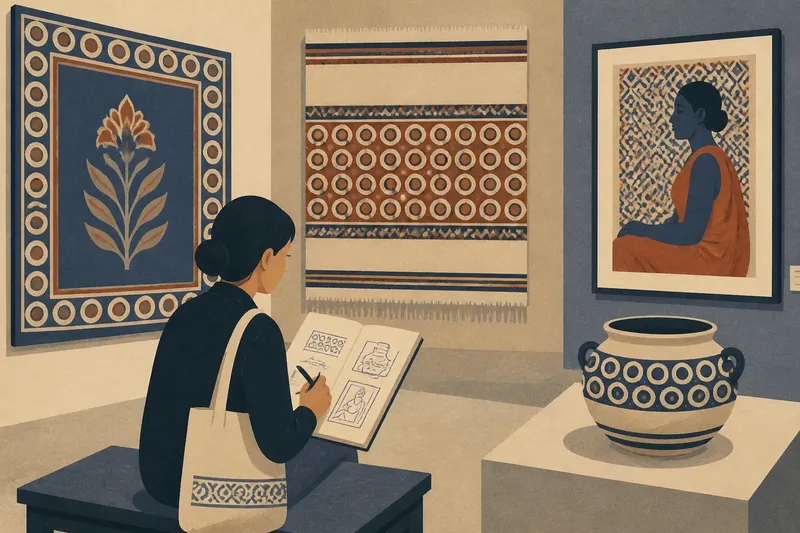
You stop at a painted panel where small circles run along the border. In another room, a woven work uses circles in a dense central band. A gallery visit built around one repeating pattern gives you a way to compare how artists arrange a shared visual form, without treating resemblance as proof of a shared origin.
Rather than tracing a motif’s supposed route, attend to the choices each artwork makes. A pattern can frame, organise or enliven a surface; its effect changes with its material and setting. Your notes can make those differences clear while leaving questions of history open for further reading.
What makes a pattern useful to follow?
A pattern is an arrangement of forms that recurs. It could be a row of circles, alternating zigzags or repeated leaf shapes. One spiral is a motif; a sequence of spirals creates a pattern you can track across several works.
Choose a description that is specific but does not depend on specialist vocabulary. “Short diagonal marks in alternating bands” is easier to compare than “lines”. If a later work changes your mind about what you are seeing, revise the description rather than forcing every example into the first category.
Simple shapes can be helpful because their placement and spacing are easy to notice. But visual similarity does not always mean two arrangements are alike in function or meaning. Keep the pattern itself distinct from any interpretation you may later consider.
How can you make a focused gallery route?
Start with one work that catches your eye, then look for similar arrangements elsewhere in the gallery. A small notebook or notes app such as Apple Notes can hold a record of each work’s title, maker, medium and location. Check gallery rules before taking photographs; a quick sketch can stand in for an image where photography is not permitted.
Choose a few works that differ in a visible way. A pattern might circle a vessel’s rim, cover a textile, or sit behind a figure in a print. Those contrasts give you something concrete to compare: where the pattern appears, what it is made from and how it relates to the rest of the work.
Use this quick record for each work:
- Check whether the pattern sits at an edge or in the centre; if it frames the work, compare its boundary with other borders, and if it occupies the centre, note what it surrounds.
- Check whether the forms are raised, woven, painted or printed; if texture is prominent, describe its surface effect, and if the marks are flat, compare their colour and arrangement.
- Check whether the forms repeat evenly or change in size and spacing; if they are regular, note the rhythm, and if they vary, record where the variation occurs.
- Check whether the pattern follows a figure, object or architectural feature; if it does, describe that relationship, and if it does not, note how it occupies the open space.
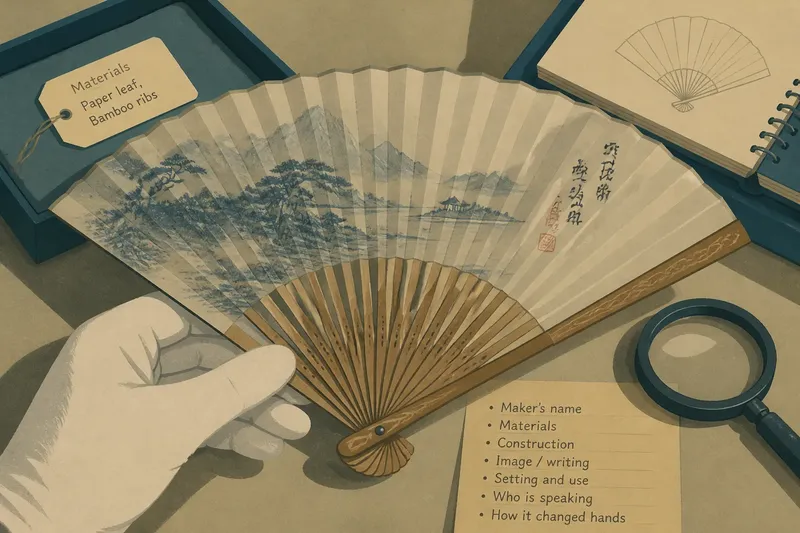
- Check the gallery label for material and context; if it provides relevant information, record it separately from your interpretation, and if it does not, leave that context as a question.
- Check whether your description distinguishes this pattern from other marks in the room; if it does, keep it, and if it does not, narrow the description by naming shape, direction or spacing.
These checks are prompts, not a scoring system. They help you decide what to inspect next and prevent a quick resemblance from becoming a complete story.
What does placement change?
Placement is one of the easiest features to describe accurately. Notice whether a pattern frames an image, marks an edge, fills an open area, follows a figure or covers a whole surface. Then ask how that position affects the way the work is organised.
A border can separate a central image from its surroundings. Repetition across a broad surface may draw attention to texture or rhythm. A pattern near a figure might make clothing or gesture more noticeable, but its meaning depends on the work and any relevant context.
Say you see a painted panel with blue diamonds around its edge, then a print where similar diamonds sit behind a figure. You write “border” for the panel and “background” for the print, and note that the diamonds frame one work but share space with a figure in the other. That is a useful comparison; it does not, on its own, tell you whether either artist encountered the other’s work.
How do material and use shape a pattern?
A pattern made by weaving has different physical qualities from one painted on a wall or carved into wood. Look closely at how the material carries the form. Does a woven band follow the structure of the cloth? Do carved lines catch light? Does paint cover a surface or leave parts exposed?
For an object, consider its shape and possible use. A design may follow a handle, rim or fold, or sit where someone would see or touch it. For an image, notice how the pattern relates to colour, subject matter and composition. It may decorate and organise at the same time.
Labels, catalogue entries and curatorial text can supply information about materials, makers, communities and customary uses. Record that context separately from what you observe. If a label explains a pattern’s significance, distinguish its account from your own reading of the work.
How can you compare works without flattening their differences?
Write down visible details before proposing an explanation. Record shape, spacing, direction, scale, colour, material and location. Then describe a possible effect, such as the repeated marks leading the eye towards a doorway or figure. Keep that interpretation tentative unless the artwork’s context supports it.
Similar forms can arise for many reasons. Artists may work with comparable materials, respond to similar design needs, invent forms independently or take part in cultural exchange. A gallery resemblance alone cannot distinguish among these possibilities.
Differences can be just as revealing as similarities. A motif may be enlarged, shifted from edge to centre, or translated from woven threads into painted marks. Describe what changes in each work and how that change affects its appearance, rather than treating every version as an interchangeable example of one tradition.
Which questions help you look more closely?
How do I choose a pattern for a gallery visit?
Choose a repeated arrangement you can recognise, such as alternating bands or a row of small rosettes. Make the description precise enough to separate it from other marks in the gallery.
What should I write down about each artwork?
Record the title and medium, then note the pattern’s position, scale, direction and material. Keep your description of what you see separate from any suggestion about what it means.
Can matching patterns show that artists influenced one another?
No, not by themselves. Similarity may raise a question about contact or exchange, but a claim of influence needs relevant historical context beyond appearance.
What if I cannot tell what a pattern means?
Describe the visible effect and mark the meaning as uncertain. A pattern can have more than one role, so an open question is more useful than an unsupported symbolic reading.
How can you turn your notes into a comparison?
Imagine your notebook contains three works with repeating waves: a ceramic bowl with waves around its rim, a painting where they cross a landscape, and a woven panel with a wavy band. You group the notes by placement, then record how each medium carries the form. Your resulting comparison is that the bowl’s waves define an edge, the painting’s waves belong to the depicted setting, and the panel’s band organises part of its surface. You leave the pattern’s history unresolved because the observations alone do not establish a route between makers.
For a gallery visit built around one repeating pattern, a useful next question is what additional context could clarify a difference you noticed. A catalogue entry, a gallery label or a conversation with a knowledgeable curator may help; if none supplies an answer, keep the question open and let the works remain distinct.