The Paper Fan’s Many Jobs Across Time
Learn how to read a paper fan through its materials, maker and setting, with practical questions that separate visible evidence from cultural assumptions.
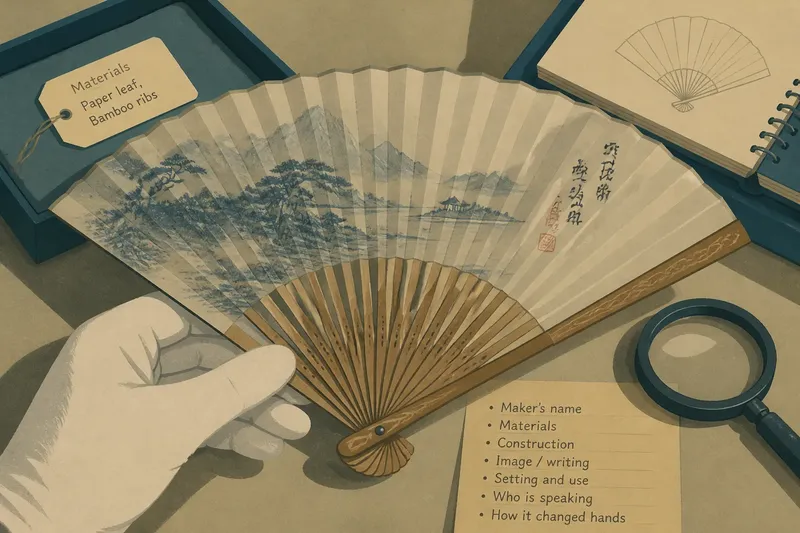
A paper fan opens with a soft snap beside a crowded doorway, then folds shut as its owner steps into the street. To understand a paper fan, look first at how it is made and used: its ribs and leaf can move air, carry an image or take part in a performance. What those features mean depends on the particular maker, holder and setting.
Fans are not a single tradition with one origin or fixed purpose. Different communities make and use them in different ways. The details of a fan can offer clues, but careful interpretation also needs information about where it was made, who uses it and what people say about it.
What does a fan’s construction tell you?
A folding fan has narrow ribs joined at a pivot and a flexible leaf, often made of paper, that spreads between them. The ribs support the leaf, which catches air and provides a surface for colour, writing or pattern. A fixed fan has a different structure, affecting how it is carried and used.
Examine the hinge, ribs and leaf before drawing conclusions. Materials such as wood, bamboo or bone may reflect availability, craft practice, cost or appearance. Paper might be plain, painted, printed or written on. These features can help describe how a fan was made, but they do not establish its origin on their own.
Imagine you are examining a folded fan in a museum case. Its patterned leaf is thin enough to show the ribs beneath it, and a short inscription sits near the edge. You can record those visible details; identifying the writing or connecting it to a maker would require further context.
How did fans serve practical needs?
A fan can move air when someone opens and waves it by hand. Because a folding fan can be closed for carrying, it is easy to take from one place to another. A broad leaf may also offer some shade or serve as a barrier between a face and dust, depending on its size and the situation.
The surface can carry decoration or writing as well. This means a fan used for cooling may also display workmanship or a design chosen by its owner. To understand its practical use, consider whether it appears indoors or outside, whether it is built for frequent handling and whether it is being used or displayed.
How can you interpret a fan’s social meaning?
A fan may be worn as part of dress, exchanged as a gift, carried for a particular occasion or used in a performance. These are possible roles, not universal meanings. A movement made during a rehearsed performance, for instance, belongs to that performance; someone waving a fan at a gathering may simply be seeking a breeze.
Context matters. Ask who is holding the fan, who else is present and what is happening. A decorated fan given as a present may have a meaning shaped by the relationship between giver and recipient. A similar fan sold to visitors as a keepsake may represent a place or community through images selected for the market.
How do you read a paper fan without assuming too much?
Combine visible details with information about the setting and accounts from people connected to the fan. A photograph or museum label may name a place or occasion but say little about ordinary use. A maker’s description or family account may add a perspective, though it should still be understood in its own context.
- Check the materials: If a label names the leaf and ribs, record those materials; if it gives no source, do not infer where they were obtained.
- Check the construction: If the ribs fold around a pivot, describe it as a folding fan; if the shape stays fixed, note that difference rather than assuming it was made for the same use.
- Check the image or writing: If a maker or knowledgeable source explains it, include that account; if not, describe what is visible without assigning a symbolic meaning.
- Check the setting: If the fan appears in a performance, consider its role in that scene; if it appears in everyday use, do not treat it as a stage prop.
- Check who is speaking: If the account comes from the maker or someone who uses the fan, identify that perspective; if the source is unclear, keep the interpretation tentative.
- Check how the fan changed hands: If it was given as a present, consider the relationship involved; if it was sold as a keepsake, distinguish that market role from the maker’s or community’s view.
Say you find a paper fan at a community market with a landscape printed across its leaf. The hypothetical starting details are a visible maker’s name, a materials label and a seller who describes it as a keepsake. First, record the name and the materials exactly as presented. Next, note that the seller’s description explains how the fan is marketed there, not necessarily what the landscape means to its maker. The resulting account can identify a present-day selling context while leaving the image’s wider meaning open unless a relevant source explains it.
What questions help make sense of a paper fan?
Is a paper fan mainly a cooling tool?
Cooling is one clear use, but a fan can also be worn, given, displayed or used in a performance. Which role applies depends on the particular fan and setting.
Does a fan’s design reveal where it came from?
A design can provide a clue when considered alongside information about the maker, materials and place of sale. A motif alone cannot establish origin, because designs may travel, be copied or gain new associations.
Do fan gestures mean the same thing everywhere?
No. A movement may belong to a local convention or a particular performance, while people elsewhere may read it differently or not treat it as a signal. Look for accounts of the specific practice before interpreting a gesture.
Why do folding fans appear in performances?
A folding fan can open, close, conceal or frame a movement, making its changing shape useful in choreography. Its surface can also contribute to the visual character of a scene.
How can you trace a fan’s history across settings?
Follow documented changes in making, ownership and use rather than assuming that one role explains every example. A fan used in a performance, for instance, can be studied through information about that performance and the people involved, without treating every similar fan as a stage object.
Trade, migration, performance and collecting can bring fans into new settings. To describe that movement, compare what is known about each fan’s maker, materials, setting and use. Keep observation separate from interpretation: “folds into a compact shape” describes a feature, while “marks a formal role” is a claim that needs context.
When you encounter a paper fan, begin with what you can see and ask who can explain what you cannot. That approach makes the fan’s construction and use easier to describe while leaving room for meanings that belong to particular people and communities.